

MARTIN International freight forwarder
Logistics with Structure
Europe-wide and worldwide transport –
for business customers only
REQUEST TRANSPORT
for business customers only
International B2B freight forwarding
We organise international transports with a focus on Eastern Europe, the Balkans, the Caucasus and Central Asia. In addition, we offer worldwide transport solutions for businesses.
Our main regions
As an international freight forwarder, we organise commercial transports with a focus on Eastern Europe, the Balkans, the Caucasus and Central Asia. Here you will find our key destination regions and the right transport solutions for your goods.
Transport to Eastern Europe
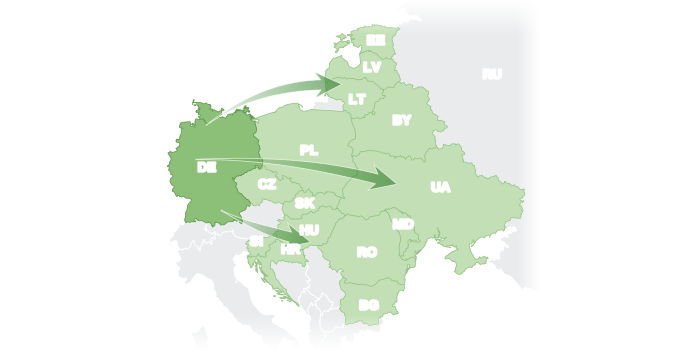
We organise road transport from Germany to Eastern Europe – as part loads, full truckloads or express deliveries. Our destinations include Poland, the Czech Republic, Romania, Bulgaria, the Baltic states, Russia, Moldova and Ukraine. Depending on the destination country, we coordinate the transport process, the delivery date and the documents required for your shipment.
Explore transport to Eastern Europe
Transport to the Balkans
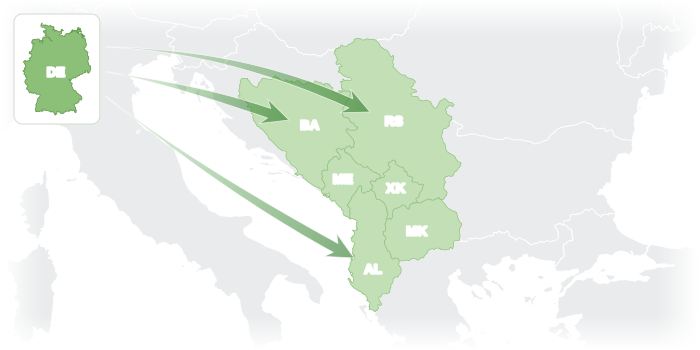
For your deliveries to Serbia, Bosnia and Herzegovina, Albania, Montenegro, North Macedonia and Kosovo, we organise part loads, full truckloads and express runs. In addition to the transport itself, we agree on the required export documents and the responsibilities for customs clearance – so you can book your commercial shipment with clearly defined services.
Explore transport to the Balkans
Transport to the Caucasus
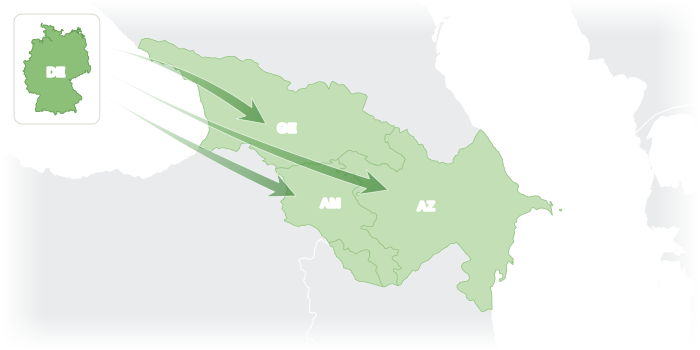
We organise transports to Georgia, Armenia and Azerbaijan. Whether palletised goods, machinery or urgent spare parts: depending on the shipment, road part loads, full truckloads or air freight are possible. Our planning takes into account the transit route, the required documents and delivery in the destination country. Details on the individual countries can be found on our transport pages.
Explore transport to the Caucasus
Transport to Central Asia
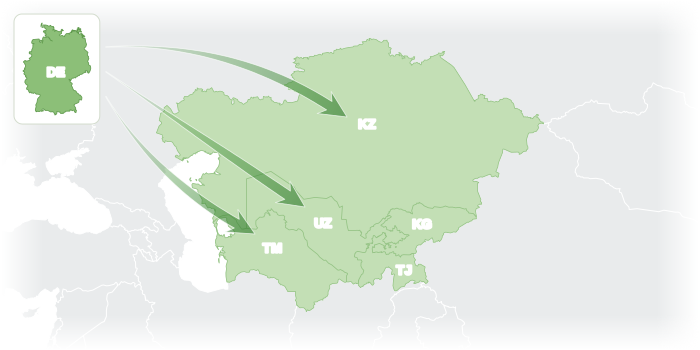
Kazakhstan, Uzbekistan, Kyrgyzstan, Tajikistan and Turkmenistan are among our Central Asian destinations. We organise part loads and full truckloads as well as air freight for time-critical shipments. Our planning takes into account the transit countries, the chosen route and the required transport documents. We agree on the mode of transport and the timeframe based on your goods and the pick-up and delivery locations.
Explore transport to Central Asia
FREE OF CHARGE AND NON-BINDING
We will get back to you the same day with a suitable freight quote for your international transport – transparent and non-binding.
All destinations at a glance
Freight forwarder for part loads and full truckloads with clear processes, dedicated points of contact, and reliable customs clearance.
We organise transports efficiently, plannably, and on schedule – from collection to delivery.


International transports:
How we organise your shipment
Would you like to ship goods within Europe or worldwide? As an international freight forwarder, we organise transports exclusively for business customers. Our focus is on Eastern Europe, the Balkans, the Caucasus and Central Asia. For your request, we need details of the goods, the pickup and delivery location and the desired date.
FREE OF CHARGE AND NON-BINDING
We will get back to you the same day with a suitable freight quote for your international transport – transparent and non-binding.
International Transport with Clear Processes — Briefly Explained
When does it make sense to hire a freight forwarder – and how do you recognise a logistics company that reliably manages international transport for B2B clients beyond standard EU corridors?
International logistics rarely fails at the actual transport stage. In practice, problems arise where processes are not clearly controlled, responsibilities are unclearly assigned, or regional requirements are underestimated. Cross-border traffic outside standardised EU routes is where it becomes apparent whether a forwarding company merely brokers international logistics or actively organises it. Businesses that need to keep transport and logistics consistently plannable therefore require a logistics provider that does not just describe processes, but controls them.
Any business looking to hire a freight forwarder expects more than pure transport handling. The decisive criteria are realistic transit times, robust planning, and clear points of contact. International logistics requires experience in coordinating complex processes, an understanding of regional markets, and structured organisational control. As a B2B freight forwarding company, Martin Internationale Spedition GmbH operates along clearly defined corridors to Eastern Europe, to the Balkan countries and to Central Asia – regions with elevated regulatory, operational, and logistical demands, where specialised experience is decisive.
Unlike general logistics companies or purely brokering platforms, our forwarding company sees itself as a controlling unit within the entire transport chain. Logistics and transport are not viewed in isolation but planned, monitored, and documented as a coherent process. Our logistics services include central organisation from Germany, ongoing coordination of all parties involved, and the transparent management of every logistical step. The result is transport logistics that remain traceable instead of fragmented.
A professional logistics provider identifies risks early and takes decisions where they are required. As a logistics provider in Germany and freight forwarder working exclusively with business customers, we deliver international logistics in a deliberately structured way. Our services as a forwarder and logistics provider are aimed at companies that want to actively control international transport rather than standardise it – with clear responsibilities, defined processes, and an organisation that takes ownership. We do not work with private individuals.
International logistics is not a mass-market product. It requires experience, regional expertise, and consistent control of complex processes. This is exactly what Martin Internationale Spedition GmbH is built for as a B2B logistics company – calmly organised, precisely executed, and traceable at every step.
Why us? Safe & on time
Request for business customers only
COMPANY & INTERNATIONAL TRANSPORTS: THE KEY FACTS
The cost of a truck transport to Eastern Europe is calculated individually for each shipment. The decisive factors are the pickup and delivery location, the type of goods, dimensions, weight, the loading space required and the date. Agreed additional services such as customs clearance or special loading and unloading requirements are added on top.
Two examples from our practice show why the quote has to match the specific shipment:
- Germany–Kyiv: a full truckload of 22 tonnes with 40 drums of ADR dangerous goods. The order included export customs clearance in Germany, organising import customs clearance in Ukraine and applying for the PP permit for the Polish–Ukrainian border crossing.
- Germany–Budapest: a custom-made steel door measuring 250 × 125 × 80 cm and weighing 540 kg. Besides the freight dimensions, loading by forklift and unloading by crane were decisive for the planning.
For your quote we need the loading and delivery address, a description of the goods, the number and dimensions of the packages, the total weight and the desired date. We agree with you which services are included in the quoted freight rate.
Yes. MARTIN organises commercial part loads to Eastern Europe, including single pallets. We accept commercial shipments of goods from 1 kg; there is no minimum volume. Private parcels, letters, document shipments and removals are not part of our services.
An example from our practice: for spare parts for medical equipment, we organised one Euro pallet from Germany to Lviv: 120 × 80 × 140 cm, 80 kg. The customer needed carriage without transhipment. We were able to carry the pallet as a part load on a vehicle running directly to Kyiv and schedule the delivery in Lviv. Carriage without transhipment must be expressly agreed in advance.
We agree with you whether your goods may be stacked. We never stack dangerous goods. Loading and unloading are generally carried out by the sender and the consignee. Driver assistance or a vehicle with a tail lift must be agreed in advance.
To prepare the transport, we need a commercial invoice and a delivery note with clear details of the goods. If you have proof of preferential origin, for example an EUR.1, please send it as well. We check which additional documents are required based on the goods, the country of destination and the agreed customs procedure.
The CMR consignment note is issued by the sender or by the performing carrier. You are welcome to send us documents you have already prepared in advance for review.
If you instruct us to handle export customs clearance, we prepare the required export declaration on the basis of your information. We distinguish between declaring the export and the later proof that the goods have actually left the EU.
For a possible customs preference, the rules of origin of the respective agreement must be met. An EUR.1 is therefore not a blanket entitlement to duty-free import.
MARTIN organises groupage by truck, part loads and full truckloads to Georgia, Armenia and Azerbaijan. Our road connections to the Caucasus run via Turkey. Depending on the goods and the date, we also offer:
- dangerous goods transports of classes 2 to 9 by arrangement; class 1 is excluded;
- oversized transports;
- temperature-controlled transports in the range of −15 °C to +18 °C;
- express runs with vans;
- air freight to Tbilisi, Yerevan and Baku with agreed onward transport to the consignee.
In Georgia we have our own transhipment warehouse. We agree on the right transport solution based on the type of goods, dimensions, weight, pickup location and delivery address.
We do not accept fresh food or chilled or frozen meat for carriage.
Georgia · Armenia · Azerbaijan
MARTIN organises commercial transports from Germany and other EU countries to Kazakhstan, Uzbekistan, Kyrgyzstan, Tajikistan and Turkmenistan. For exports from the EU, we plan groupage, part loads, full truckloads or air freight, depending on the shipment.
We also assess dangerous goods, oversized, temperature-controlled and express shipments against the specific requirements. Before you place the order, we agree on the route, the documents, the customs responsibilities and the delivery point. Onward transport from the customs terminal to the consignee's warehouse can be part of the order.
The direction of transport matters: for deliveries from the EU to Central Asia, we also accept small commercial shipments from 1 kg. In the opposite direction, MARTIN currently has no comparable regular groupage service. We assess return transports to the EU individually, especially as full truckloads.
The delivery time depends in particular on the destination, the mode of transport, the pickup date, the route, border clearance and the completeness of the documents. For truck transports from Germany, the following guide values apply up to the agreed customs terminal or customs warehouse at the destination:
| Destination | Part load | Full truckload |
|---|---|---|
| Georgia: Tbilisi, Batumi or Kutaisi | 2–2.5 weeks | 1–1.5 weeks |
| Yerevan, Armenia | 2.5–3 weeks | 1.5–2 weeks |
| Baku, Azerbaijan | 2.5–3 weeks | 1.5–2 weeks |
| Tashkent, Uzbekistan | 4–5 weeks | 2–2.5 weeks |
| Astana, Kazakhstan | 3.5–4 weeks | 2–2.5 weeks |
Import customs clearance and the last mile are not included in these times. The values are for planning purposes; we agree the time frame for your specific shipment before you place the order.
For time-critical shipments we look at express runs. To Armenia and Azerbaijan, for example, vans for up to 800 kg and up to four Euro pallets of 120 × 80 × 140 cm each are possible. Whether express or air freight is the better option, we decide based on the required arrival date.
For our B2B transports, the sender usually organises export customs clearance and the consignee import customs clearance. After an individual review and on express instruction, MARTIN can organise both steps as additional services.
For the export, we help to prepare the declaration and compile the required information, for example commodity codes, goods values and net and gross weights per item. Whether we can prepare and apply for an EUR.1, we check on the basis of the required proofs of origin.
In the country of destination, we can coordinate import clearance through a local customs broker. The consignee pays the import duties and taxes directly to the competent authority.
After customs release, the consignee collects the goods at the agreed customs location, or we organise the previously agreed onward transport to their warehouse. We clarify responsibilities and the scope of services before the transport starts.
An international freight forwarder organises cross-border transport in line with the agreed order. At MARTIN, this means agreeing on the mode of transport and the route, selecting the performing transport partner and coordinating pickup, documents and delivery. Customs services and additional transport insurance are reviewed and agreed separately where required.
MARTIN works with long-standing, proven transport partners and is certified to DIN EN ISO 9001:2015. Your contact person coordinates the agreed services and answers questions about the transport process.
An order to Chișinău shows which tasks can be involved: ten Euro pallets with 3,600 kg of fabric were to be made into clothing in Moldova and then transported back to Germany as finished goods. In addition to the carriage, the customs procedures for export, processing and subsequent re-import had to be coordinated.
MARTIN organises truck transports within Europe, including Eastern Europe, as well as to Turkey, the Caucasus and Central Asia. This covers groupage, part loads and full truckloads and, by arrangement, express, dangerous goods, oversized and temperature-controlled transports.
For these regions and other international destinations, including the Americas and Asia, we offer air freight with agreed customs clearance and onward transport to the consignee. We assess combinations of truck and rail based on the specific route. We do not offer sea freight; rail transports to and from China are currently not available.
In addition, after an individual review, we can organise export and import customs clearance and additional transport insurance. In Georgia we have our own transhipment warehouse.
Our services are aimed exclusively at business customers with commercial shipments of goods. We do not handle private removals or letters, documents and private parcels.
For a transport quote, MARTIN needs the pickup and delivery address with postcode and country, an exact description of the goods, the number and type of packages, the dimensions of each package, the total weight and the desired pickup date.
Depending on the shipment, please also provide:
- Express: the required arrival date;
- Dangerous goods: the hazard class and any other available dangerous goods details; for air freight, the safety data sheet where required for the goods;
- Oversized cargo: a drawing with exact dimensions and weight, as well as details of the packaging and the weather protection required;
- Loading and unloading: the loading equipment available and any driver assistance or tail lift required;
- Additional insurance: the value of the goods and the agreed Incoterms.
For many EU transports, we can calculate a price within 20–60 minutes. For a same-day quote, please send complete requests for Central Asia by 12:00 at the latest and for the Caucasus and non-EU countries in Eastern Europe by 14:00 at the latest. The actual processing time depends on the shipment and the services to be checked.